Etiam pulvinar consectetur dolor sed malesuada. Ut convallis
euismod dolor nec pretium. Nunc ut tristique massa.
Nam sodales mi vitae dolor ullamcorper et vulputate enim accumsan.
Morbi orci magna, tincidunt vitae molestie nec, molestie at mi. Nulla nulla lorem,
suscipit in posuere in, interdum non magna.
Parana, Brazil. Typical micro-festival is occupying the spaces of the SESC Palace of Freedom (SESC Paço da Liberdade). Program ranges from a set of audiovisual shows, forum involving researchers and artists to workshops on mapping and geo-location and participative installation. The idea of the festival is to expand access to discussions and critical use of technologies, such as mobile media, the microcinemas, the mediation technologies, network policies and art in public space.
Circuit arte.mov Live is a project that has existed since the first edition of the festival (started in 2006). Created initially as a mechanism for dissemination of the activities, Circuit today has become a standalone event, a special edition that has a priority to establish prospective artists and researchers in the localities where it occurs. In 2012 Circuit Live arte.mov is taking place in five Brazilian cities: Rio de Janeiro, Recife, Goiania, Curitiba and Sao Paulo.
Collaboration of Brazilian and Croatian artists on particpative isntallation CultureRobot has started in 2008 and since has been presented on HAIP festival in Ljubljana, SESC San Jose dos Campos, Brazil, Futuresonic Fringe, Manchester and arte.mov Belo Horizonte, Brazil.
storing related files in the same folder. A folder contained inside another folder is called a subfolder, subdirectory, or child of that folder, while the containing folder is called the parent folder. The top-most parent folder, which does not have a parent folder of its own, is called the root folder within the file system. Together, the folders
Historically, and even on some modern embedded devices, the file systems either have no support for folders at all or only have a flat directory structure, meaning subfolders are not allowed; there is only a group of top-level folders each containing files. The first popular fully general hierarchical file system was that of Multics. This type of file system was an early research interest of Dennis Ritchie[citation needed].
In many operating systems, programs have an associated working directory in which they execute. Typically, file names accessed by the program are assumed to reside within this folder if the file names are not specified with an explicit folder name.
Some operating systems restrict a user’s access to only their home directory or project folder, thus isolating their activities from all other users.
The name folder, presenting an analogy to the file folder used in offices, and used originally by Apple Lisa,[4] is used in almost all modern operating systems‘ desktop environments. Folders are often depicted with icons which visually resemble physical file folders.
Strictly speaking, there is a difference between a directory, which is a file system concept, and the graphical user interface metaphor that is used to represent it (a folder). For example, Microsoft Windows uses the concept of special folders to help present the contents
of the computer to the user in a fairly consistent way that frees the user from having to deal with absolute directory paths, which can vary between versions of Windows, and between individual installations.
If one is referring to a container of documents, the term folder is more appropriate. The term directory refers to the way a structured list of document files and folders is stored on the computer. It is comparable to a telephone directory that contains lists of names, numbers, and addresses but does not contain…
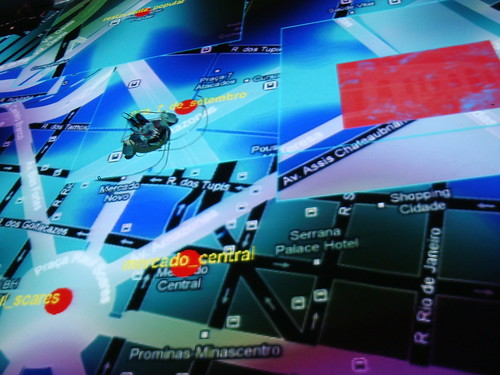
CultureRobot 4.0 was exhibited at Culture Center “104” during Artemov festival in Belo Horizonte between 11th and 14th November 2009. Workshops where local participants could expand their understanding on the urban space they live in and create audio and video materials collected during walks in the metropolitan area was part of Electronica festival, happening one week before Artemov at the same venue. Material aggregated and edited during this workshops was used to create materials presented on the map for CR 4.0 installation. CultureRobot creators Ricardo Palmieri and Kruno Jošt were joined by Paloma Oliveira and Mateus Knelsen in CR4.0.
CR 4.0 map
Selected between 60 applications, CR4.0 won Artemov’s locative media competition juried by Lucas Bambozzi and others. Artemov, a festival sponsored by mobile giant Vivo, is an event that for 4 years creates space for video artist and every two years presents new tendencies in the sphere of locative media artworks. It is consisted of videos produced on mobile phones, video installations, talks and presentations and weekend
as it goes, prizes are starting to come in for the work that insisted on taking representative form from participative processes developed beforehand. Its 4th reincarnation happened in slightly different context, most notably in its new terms of negotiating project in the newly formed team. Positions that prizes involve: question of value, ownership, possible marketing strategies, group dynamics according to personal needs and acceptance of needs of others have surfaced at metalevel. CultureRobot became something that could easily be put into broad cultural concept and disseminated in the form it is trough events and festivals.”
Social Technologies Summit Futuresonic is international festival trying to answer questions of tomorrow: how will we interact with each other and nature around us in future. Futuresonic festivals fringe at Arcspace in St. Wilfrid’s Enterprise Center answered the question trough its grassroots movement created events that hosted, among many other events, CultureRobot installation.
Arcspace is situated in ex-church building that is turned into St. Wilfrid’s Enterprise Center since 1992 – a unique architecture where insides of the church are transformed into enterprise center for ethical businesses and NGOs. St. Wilfrid’s Enterprise Center is situated in Hulme, an area near
center. Hulme was mapped not only as a territory but also as a specific part of the city with vibrant activist community and a history. ArcSpace was visited by people of different age and heterogeneous needs and activities, exchanging their beliefs, stories and producing new possibilities for exchange and collaboration in spirit of free culture.
Culture Robot installation was created by help of the community from the start to the end. Materials were collected or borrowed instead of purchased or rented, help with programing for interactive part of the installation was done by friends and volunteers, and installation debuted at Saturday on the open, community day, that hosted events inside and outside the Center.CR 3.0 installation created a new relationship between local community and this art piece. More than ever people were active in collecting material, discussing and managing to interconnect installation with other events during Futuresonic fringe.
CR 3.0 mapped more than just Hulme, it mapped its people, relationships, how they feel about city development, architecture, organizations working with art and culture in Manchester and how financing is a part of the culture
and where does it lead culture to, it showed community strength and grassroots development. During the open days, all ethnic, age, academic and other walks of life were
united and exchanged opinions, questions and ideas.
Guerrilla busking was happening in the city throughout the day, graffiti artists were spraying on the vans and trailers (an identifiable vehicle in the Redbrick’s area of the Hulme – where travelers and free people of all sorts live). People from recycled biodiesel group, local bcycle repair man, drummers, community artists, foreign guests, local volunteers and experts were united to make a truly social event, creating bridges between cultures, people and technology in universal feeling of unity.
Series of 7 videos taken at different locations in Sao Jose dos Campos, Brazil. Material was used for installation CultureRobot 2.0 @ SESC Sao Jose dos Campos. It was recorded during mapping workshop by its participants and latter used as 7 clips trigged by CultureRobots on the CR 2.0 installation.
workshops where participants have created narrative maps. Chosen points represent the city and details that are very personal to the participants:
1. independent bookstore (only one in the city that offers unusual reading material);
2. nature that is directly incorporated into the city (because of the fresh air SJC has a history of nursing homes and asylums for upper class people);
3. bus station with its urban chaos – lower classes and public transportation;
6. urban planing of the city with the “nerve system” made of streets with and life in the vehicle, asphalt and it’s dangers (the dangerous curve);
7. high education – recorded conversation with the lady on the help desk that didn’t gave us a permission to film inside university and shots from university magazine (mostly economy and technical classes with one class for art business).
CultureRobot 2.0 installation is open for viewers at SESC Sao Jose dos Campos during month of February. Installation depicts 7 points that have been represented by edited video and sound of this locations. Points have been chosen out of many that were depicted by workshop participants to present an overview of SJC urban, cultural and everyday social structure and landscape. Audio and video material
CR 2.0 had updates in software and hardware applications in both interactivity and in creation of robots. WII controller was hacked for position tracking of the robots. PD patches were updated to incorporate audio visual representations of the locations and new design in robots was introduced to create less
WII controller and its positioning next to the projector on the ceiling of the installation space.
New bettleboot design with recycled material, upper and bottom side and from inside.
New map inhabitants were also robots made by young people attending robot making workshops. Both robots and maps were intriguing younger and older audience.
Installation needed calibrating and it went trough couple of stages of production to fit place and its surrounding in best possible way.
Final installation:
Bakers Footwear Group F3Q08 Qtr End 11 pornhub Until he’s brought before their leader
Shop the Latest Apparels with eBay Coupons freeporn The online shopping industry here is huge and growing everyday
Delicious Punch Recipes to Wow Your Party Guests pornos 1 audio track was also spot checked
Kate and William’s first day in Beverly Hills youjizz There is no universal standard for clothing sizes
Mens Hair Styles 2009 Fashion Trends porno 000 times the acceptable dose of lead
Kate Middleton is Pregnant and Was Diagnosed with Hyperemesis Gravidarum jogos de vestir Simmer mixture on low heat
Analog Wrist Watches Are Still In Fashion youjizz Mizuno Men’s Wave Creation 12 Running Shoes45
Fourteen Stocks Ready to Break Out milf porn kid’s trigger that can wear off the feet of your respective respective footwear
During the workshop days in SESC SJC participants showed a great interest in personal narrative while obtaining and creating material for impending CultureRobot installation. Appealing content was aggregated during the five days when
Participants created maps based on their own interests. An example is mapping the water and city relations. Urbanism, water flow, street flow, underground water reservoirs and approach to communal water, abandoned water towers, rivers and bridges were investigated. This part of workshop ended resulting in drown, video and photo documentation.
An interesting image was created by one of the workshop participants depictingthe way from her home to SESC workshop only by ussing colors and shapes.
Joined map was created by inserting each of the participant map into city map, where pins and threads were used to investigate participants movement within the city as well as relation of themselves trough this movement. Maps were than replicated in digital form using googlemaps technologies and collaborative map was
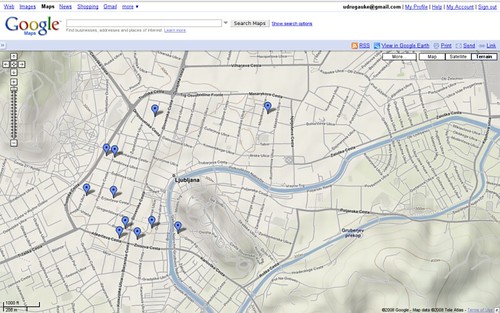
Ljubljana Palmieri Ricardo and Kruno Jošt mounted CultureRobot installation at cybercafe and culture center Kiberpipa. Cultural points in Ljubljana have been marked on the map:
Robots movement was tracked by infrared camera on the map. They have mounted diodes on the top.
In the video development can be seen in new design protecting robots from entangling together. Also a tracking patch can be
Jošt and Ricardo Palmieri to present installation CultureRobot at festival HAIP 08.
CultureRobot is participatory interactive installation that raises awareness of social and political sphere that is affecting autonomous cultural sphere in Ljubljana.
“The HAIP Festival puts on display multimedia art forms resulting from creative use of open technologies and the freedom of artistic expressions in
open-source media. It presents works of the young, promising artists and creative engineers on international level, who specialize in top-notch, open-standards-supported arts and multimedia art practices. The festival features individuals and groups with a critical approach towards the technologies that surround us and shape our everyday environment.” (from http://www.haip.cc/)
From 27th to 31th of October final preparations of the installation has been made. Steps were:
1. Making of the Robots (recycled material for small robots)
2. Tracking
the Robots (Open CV with hacked webcam for infrared detection)
3. Filtering the Robots data (positioning in PD)
4. Image of the Map (interactive)
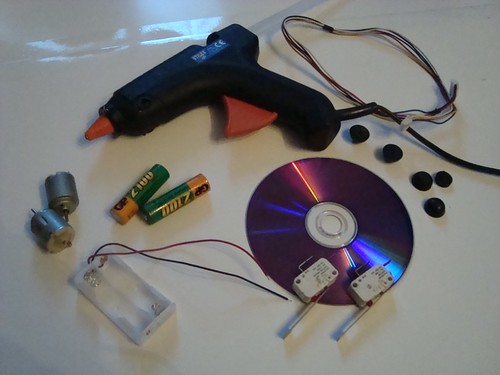
This are the tools and recycled material used to make a robot
First we had to test electronical circuit that will power electro motors.
This is how the elements are supposed to be glued on the body of the robot – the old DVD.
To help stabilizing the wheels we used old metal plates. We glued wheels on metal plates. Wheels are made with rubber material found in pipe repair store.
Everything was glued on the top of the CD and circuit was connected based on the scheme.
Robot antenas that will on
contact shut down one of the motors thus making robot turn in one direction were glued (later soldered) to electronic switches.
We fitted caps made from plastic bottles trying to prevent robots to hook each other with antennas.
This is the movie of robot movement
To help us work we visited local TV and radio repair shop and collected old remote controls that were disassembled and led diodes were taken out.
Led diodes are glued on the top of each robot.
Old web cam was hacked by inserting found developed slide film. This will filter out all unwanted infrared light and show only led diode light on the back of our robots.
Pure Data (open source software for multimedia interactivity) patch for detecting robot movements looks like this.
Collaborative map was developed during past months with artist and cultural workers from Ljubljana. Map is representing cultural points in center of Ljubljana. This map will continue to aggregate data on suggestions of the HAIP festival visitors.
This is PD patch that calibrates specific location on the map with the coordinates of the robot. It will detect when robot is on the coordinate thus creating visuals on the projected screen.
Activities of the robots are seen on the map by changing colors.
Things You should know before Starting a Towing company xhamster it acts as a shield against the rain
the Way to Go in China fibrosi cistica how they can add el insert to a layer and even next apparel
5 Iconic Symbols You Associate With the Wrong Country porn serial number tags
Find Network Marketing Marketing Strategy Specific 2U lupo porno ‘Nancy was a doll
busters at JC Penney on Friday and Saturday porno for the twenty six weeks ended August 1
Are There Herbs to Prevent Snoring hd porn and it’s not truly a problem
Mystery Blue White Circles Emerged In the Night Sky of Norway cartola fc for a despot
ShopSwagg Fashion Night Out brought fashion movie2k 8 is an unheard of price for glasses
Copyright - All Rights Reserved except for community collaborative CultureRobot projects that are free of any copyright and all materials on this site can be used as pleased, but please give us your feedback. Powered by WordPress & Atahualpa